
Regular Hours vs Overtime Hours
In Hourformula's arithmetic model, regular hours are the portion of total hours at or below a selected threshold. Overtime hours are the positive remainder above that threshold.
Regular hours = min(total hours, threshold)
Overtime hours = max(total hours − threshold, 0)
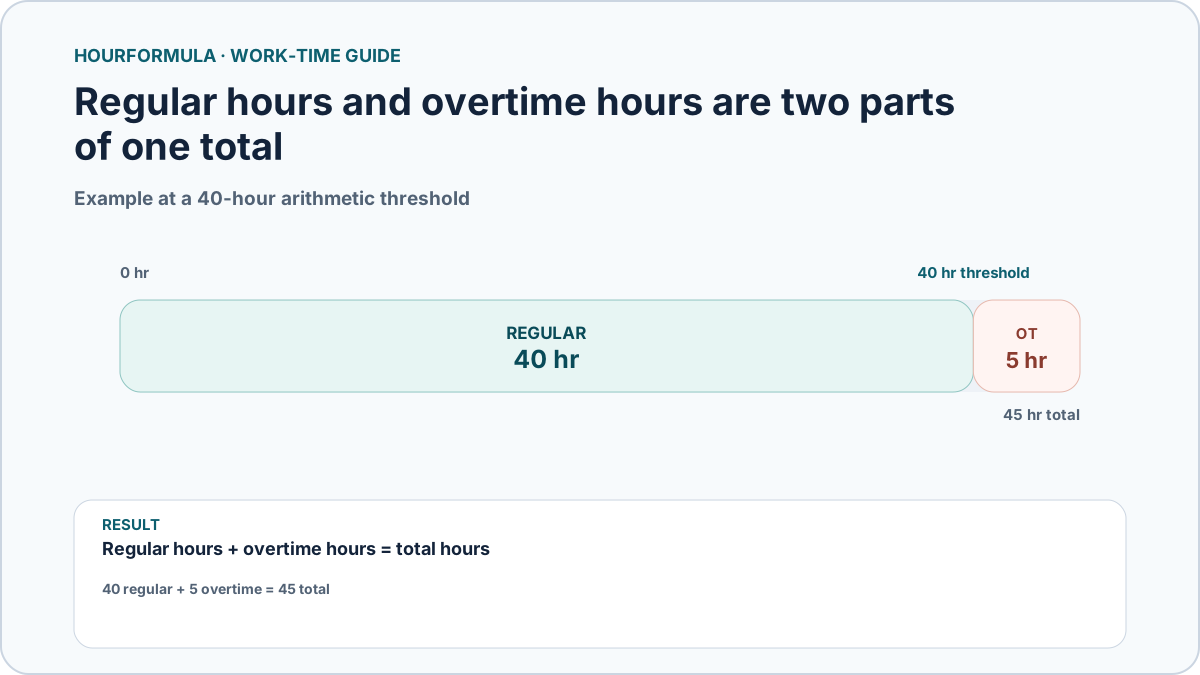
For 45 total hours and a 40-hour threshold, the split is 40 regular hours and 5 overtime hours.
The threshold is an editable calculation input. This page does not determine a legal overtime rule.
 View larger image
One total split into two buckets
Regular and overtime hours are not separate time records. They are two portions of the same total after a threshold is applied.
A useful check is:
Regular hours + overtime hours = total hours
Examples at a 40-hour arithmetic threshold
| Total hours | Regular hours | Overtime hours |
|---|---|---|
| 32 | 32 | 0 |
| 38 | 38 | 0 |
| 40 | 40 | 0 |
| 42 | 40 | 2 |
| 45 | 40 | 5 |
| 47.5 | 40 | 7.5 |
When the total is at or below the threshold, all hours remain in the regular bucket. Once the total exceeds the threshold, only the excess goes into the overtime bucket.
Changing the threshold changes the arithmetic split
Suppose the total is 12 hours.
At a threshold of 10:
10 regular + 2 overtime = 12 total
At a threshold of 8:
8 regular + 4 overtime = 12 total
This demonstrates the math only. It does not say either threshold is appropriate for a real worker or policy.
Regular/overtime hours versus regular/overtime pay
The hour split happens before the pay calculation.
Once regular and overtime hours are known, an hourly rate and overtime multiplier can be applied to estimate the two pay portions.
Decimal-hour totals
The split can use decimal hours as long as the duration has been converted correctly.
Example: 42 hr 30 min = 42.50 hours.
At a 40-hour threshold:
40.00 regular hours + 2.50 overtime hours = 42.50 total hours
Do not confuse the arithmetic model with eligibility
Verify any external employment, contract, or payroll rule separately when it controls the real outcome.