
How to Calculate Overtime Pay
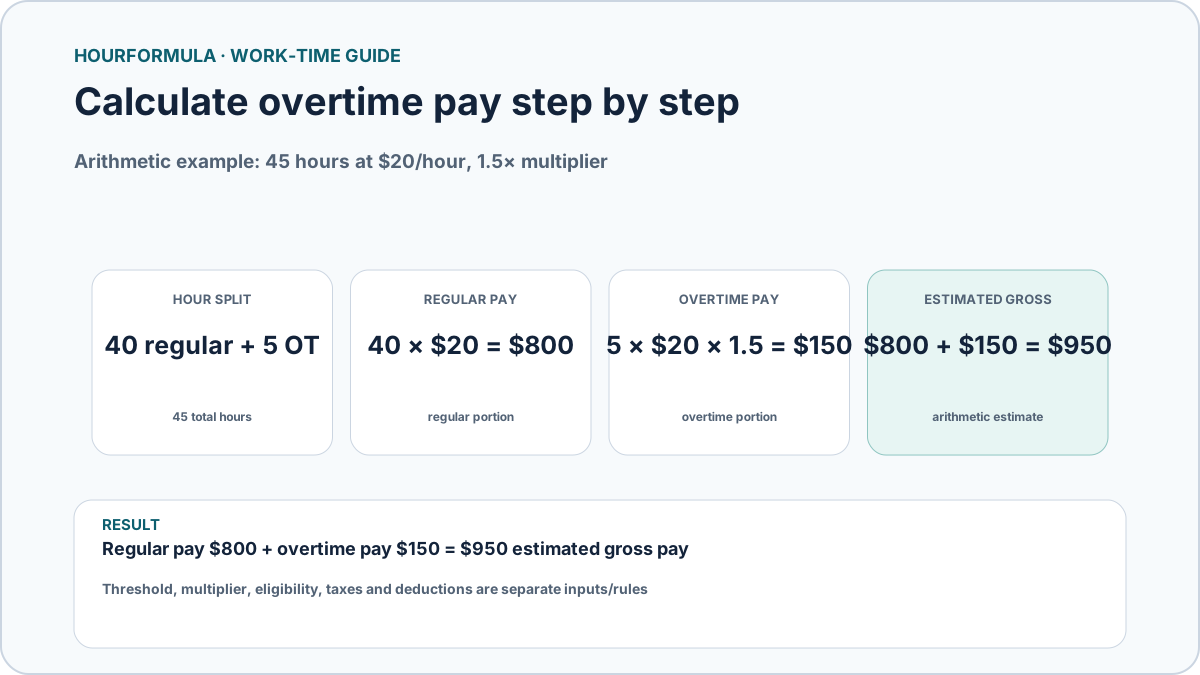
To estimate overtime pay, first split total hours into regular and overtime hours, then apply the hourly rate and selected overtime multiplier.
Regular pay = regular hours × hourly rate
Overtime pay = overtime hours × hourly rate × multiplier
Estimated gross pay = regular pay + overtime pay
Hourformula performs this arithmetic using the values you enter. It does not determine eligibility, taxes, deductions, or which multiplier or threshold applies.
 View larger image
Worked example: 45 hours at $20 per hour
Assume these arithmetic inputs:
- total hours: 45;
- hourly rate: $20;
- regular-hours threshold: 40;
- overtime multiplier: 1.5.
First split the hours:
Regular hours = 40
Overtime hours = 45 − 40 = 5
Calculate regular pay
Multiply the regular hours by the hourly rate:
40 × $20 = $800 regular pay
Calculate overtime pay
Apply the multiplier to the base rate for the overtime portion:
$20 × 1.5 = $30 overtime rate
Then multiply by the overtime hours:
5 × $30 = $150 overtime pay
Add the two portions
$800 + $150 = $950 estimated gross pay
| Component | Arithmetic result |
|---|---|
| Regular hours | 40 |
| Overtime hours | 5 |
| Regular pay | $800 |
| Overtime pay | $150 |
| Estimated gross pay | $950 |
What if there are no overtime hours?
If total hours do not exceed the selected threshold, the overtime portion is zero.
Example: 38 hours at $20 with a 40-hour threshold:
Overtime hours = 0
Regular pay = 38 × $20 = $760
Estimated gross pay = $760
What changing the multiplier does
The multiplier affects only the overtime pay portion in Hourformula's arithmetic model.
For 5 overtime hours at a $20 base rate:
| Multiplier | Overtime-rate arithmetic | Overtime pay |
|---|---|---|
| 1.0 | $20 × 1.0 = $20 | $100 |
| 1.5 | $20 × 1.5 = $30 | $150 |
| 2.0 | $20 × 2.0 = $40 | $200 |
These are numerical examples, not statements about which multiplier should apply.
Use precise time before calculating pay
If worked time includes minutes, convert or total the time accurately before multiplying by a rate.
For example, 7 hours 30 minutes is 7.50 hours, not 7.30 hours.
When several entries contain repeating decimal fractions, keeping exact minutes until the total is complete can reduce rounding differences.
What this estimate excludes
Treat the calculator output as the result of the supplied numbers, not as a payroll statement.