
What Are Decimal Hours?
Decimal hours express time as a base-10 number instead of using hours and minutes separately.
For example:
- 8 hours 0 minutes = 8.00 hours
- 8 hours 15 minutes = 8.25 hours
- 8 hours 30 minutes = 8.50 hours
- 8 hours 45 minutes = 8.75 hours
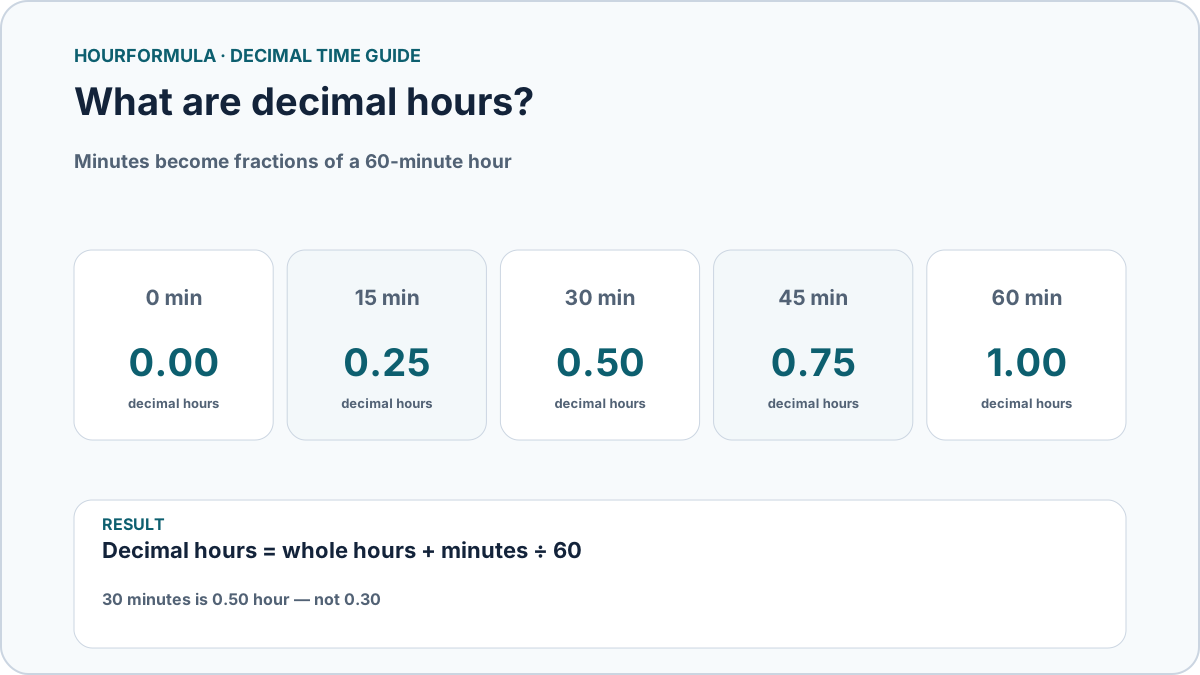
The key rule is that minutes are converted as a fraction of 60, because one hour contains 60 minutes.
Decimal hours = whole hours + minutes ÷ 60
So 8 hours 30 minutes becomes:
8 + 30 ÷ 60 = 8.50 hours
It does not become 8.30 hours.
 View larger image
Why decimal hours are different from clock time
Clock time uses a base-60 system for minutes.
A clock reading such as 8:30 means eight hours and thirty minutes. The digits after the colon are minutes, not decimal fractions.
Decimal hours use base 10. The digits after the decimal point represent a fraction of one hour.
That is why:
8:30 ≠ 8.30 decimal hours
Thirty minutes is half of an hour:
30 ÷ 60 = 0.50
Therefore:
8 hr 30 min = 8.50 decimal hours
Common minute-to-decimal conversions
| Minutes | Decimal hours |
|---|---|
| 5 | 0.0833… |
| 10 | 0.1667… |
| 15 | 0.25 |
| 20 | 0.3333… |
| 30 | 0.50 |
| 40 | 0.6667… |
| 45 | 0.75 |
| 50 | 0.8333… |
| 60 | 1.00 |
Quarter-hour values are especially simple because 15, 30, and 45 minutes divide evenly into quarters of an hour.
For a wider range of minute values, use the reference chart:
How to convert hours and minutes to decimal hours
Keep the whole hours, then divide the minute portion by 60.
Example:
7 hr 20 min
Whole hours:
7
Minute conversion:
20 ÷ 60 = 0.3333…
Add them:
7 + 0.3333… = 7.3333…
Rounded to two decimal places:
7.33 hours
Another example:
4 hr 45 min
45 ÷ 60 = 0.75
So:
4.75 hours
How to convert decimal hours back to hours and minutes
Keep the whole-number portion as hours, then multiply the decimal fraction by 60.
Example:
6.75 hours
Whole hours:
6
Decimal fraction:
0.75
Minutes:
0.75 × 60 = 45
Result:
6 hr 45 min
For 6.25 hours:
0.25 × 60 = 15
Result:
6 hr 15 min
Decimal hours in work-time calculations
Decimal hours are useful when a duration needs to be added, averaged, or multiplied by another number.
Suppose a worked shift totals:
7 hr 30 min
Convert the minutes:
30 ÷ 60 = 0.50
So the duration becomes:
7.50 hours
That decimal value is easier to use in arithmetic than a mixed hours-and-minutes format.
For example, if you are comparing several daily totals:
| Day | Hours & minutes | Decimal hours |
|---|---|---|
| Monday | 8 hr 0 min | 8.00 |
| Tuesday | 7 hr 30 min | 7.50 |
| Wednesday | 8 hr 15 min | 8.25 |
Decimal notation makes numerical addition straightforward:
8.00 + 7.50 + 8.25 = 23.75 hours
23.75 hours converts back to:
23 hr 45 min
Rounding decimal hours
Some minute values do not produce a terminating decimal.
For example:
10 ÷ 60 = 0.166666…
and:
20 ÷ 60 = 0.333333…
For display, these may be rounded to values such as 0.17 and 0.33.
However, repeatedly adding rounded values can create small differences.
When accuracy matters:
- keep the original minutes;
- total the minutes;
- convert the final result to decimal hours;
- round only when needed for display.
Common decimal-hour mistakes
Writing 30 minutes as .30
Thirty minutes is 0.50 hours, not 0.30.
Treating 45 minutes as .45
Forty-five minutes is:
45 ÷ 60 = 0.75 hours
Rounding each entry before totaling
If several values contain repeating decimal fractions, early rounding can slightly alter the final total.
Confusing a clock time with a duration
8:30 AM is a time of day.
8 hr 30 min is a duration.
8.50 is that duration written as decimal hours.