
How to Calculate Overtime Hours
To calculate overtime hours arithmetically, compare total hours with a chosen regular-hours threshold.
Overtime hours = max(total hours − threshold, 0)
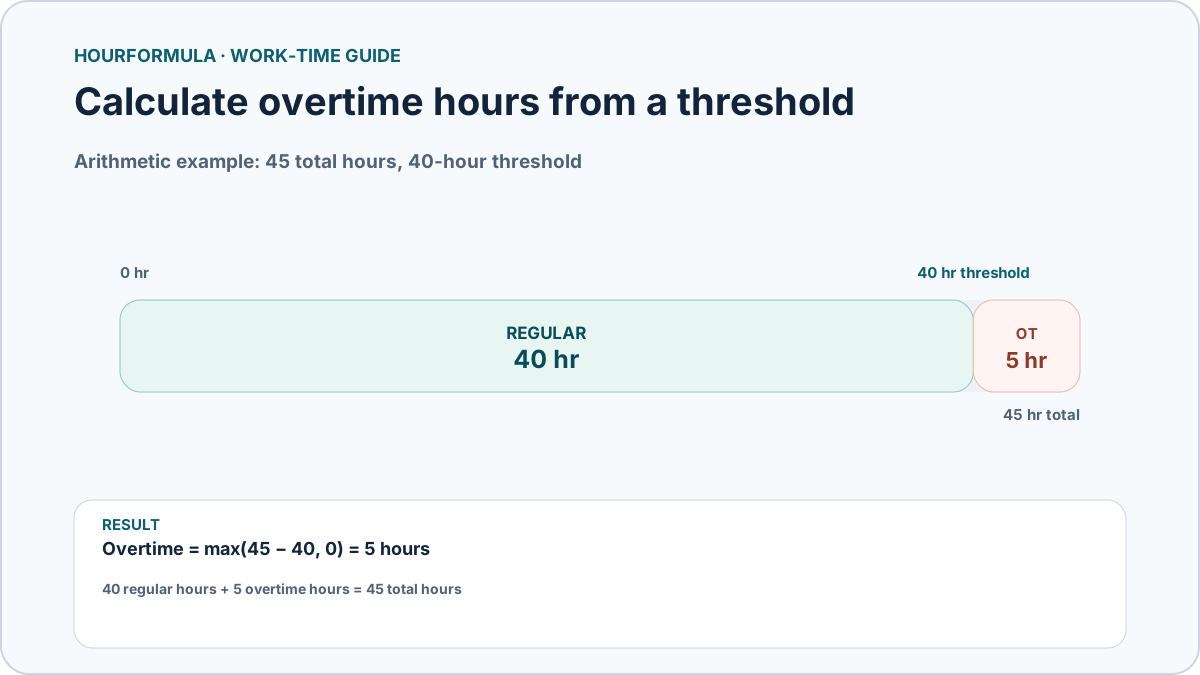
For example, if total hours are 45 and the selected threshold is 40:
45 − 40 = 5 overtime hours
Hourformula lets you edit the threshold. The calculation does not decide which threshold legally applies to a particular worker or situation.
 View larger image
Step 1: Start with the total hours
Use a completed worked-time total before splitting hours into regular and overtime portions.
If your source is a time card, first account for clock-in and clock-out times, overnight shifts, and any excluded breaks.
For example, a weekly worked-time total might be 45.00 hours.
Step 2: Choose the arithmetic threshold
The threshold is the point used to split the total into two numerical buckets.
Hourformula's Overtime Calculator starts with 40 hours as an editable default, but the field is an input rather than a legal conclusion.
If a different arithmetic scenario requires another threshold, enter that value deliberately.
Step 3: Find the amount above the threshold
Subtract the threshold from total hours.
If the result would be negative, overtime is zero.
| Total hours | Threshold | Overtime hours |
|---|---|---|
| 38 | 40 | 0 |
| 40 | 40 | 0 |
| 42 | 40 | 2 |
| 45 | 40 | 5 |
| 46.5 | 40 | 6.5 |
Regular hours are the complementary portion
Regular hours are the part of the total at or below the selected threshold.
Regular hours = min(total hours, threshold)
At 45 total hours with a 40-hour threshold:
- regular hours = 40;
- overtime hours = 5;
- total = 45.
The two portions should add back to the original total.
What if total hours are below the threshold?
Do not produce a negative overtime value.
For 32 total hours with a 40-hour threshold:
max(32 − 40, 0) = 0 overtime hours
All 32 hours stay in the regular arithmetic bucket.
Decimal overtime values
The same formula works with decimal hours.
Example:
43.75 total − 40 threshold = 3.75 overtime hours
3.75 hours corresponds to 3 hours 45 minutes.
This calculation does not determine eligibility
Use the threshold that is appropriate for the arithmetic scenario you are modeling, and verify any external rule separately when it matters.