
How to Calculate Work Hours With Lunch
To calculate work hours with lunch, first calculate the full time from clock-in to clock-out, then subtract the lunch period if that lunch is unpaid.
Worked time = clock-out − clock-in − unpaid lunch
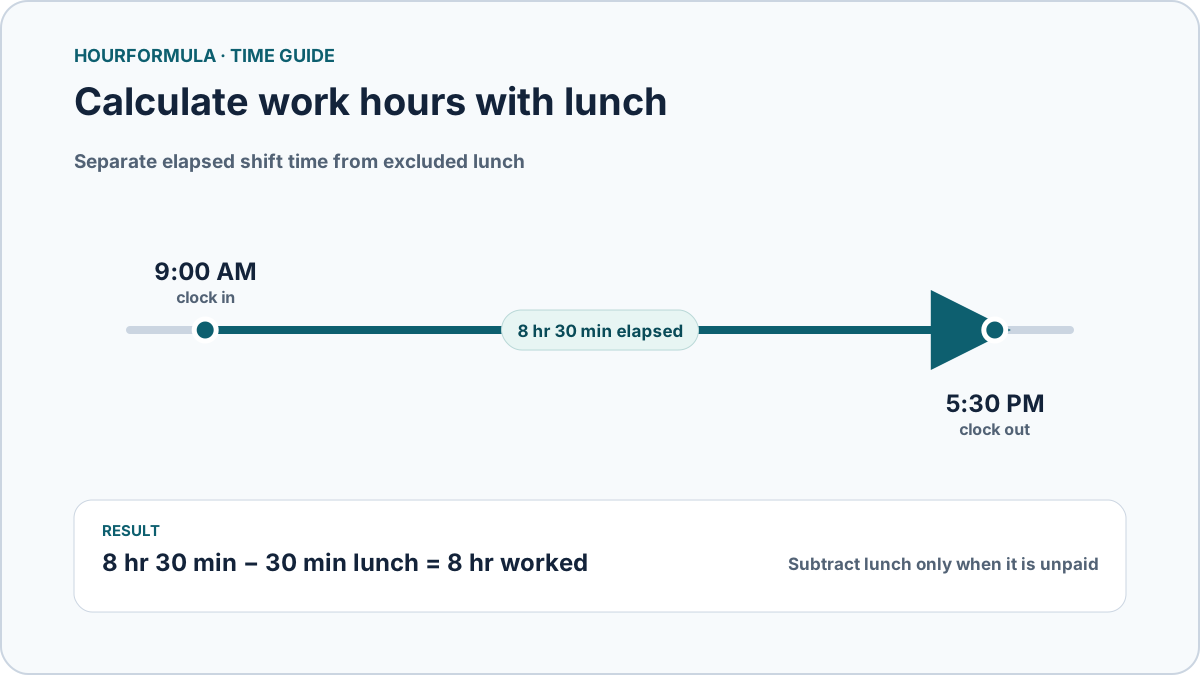
For example, if you work from 9:00 AM to 5:30 PM and take a 30-minute unpaid lunch:
- 9:00 AM to 5:30 PM = 8 hours 30 minutes
- Subtract 30-minute lunch
- Hours worked = 8 hours
The key distinction is between elapsed shift time and worked time. Lunch changes worked time only when that lunch should be excluded.
 View larger image
Calculate the full shift first
Start with the time between clock-in and clock-out without considering lunch.
Example:
- Clock in: 8:15 AM
- Clock out: 4:45 PM
Elapsed span:
8 hours 30 minutes
Now suppose there is a 30-minute unpaid lunch:
8 hr 30 min − 30 min = 8 hr worked
Keeping these as two separate calculations makes the result easier to check.
Example: 9-to-5 with lunch
A 9:00 AM to 5:00 PM shift spans 8 hours.
If lunch is 30 minutes and unpaid:
8 hr − 30 min = 7 hr 30 min
If lunch is 60 minutes and unpaid:
8 hr − 1 hr = 7 hr
If lunch remains part of counted work time, no lunch deduction is made and the total remains 8 hours.
The arithmetic depends on whether the break should be excluded, not simply on the fact that lunch occurred.
Work-hours examples with different lunch lengths
Table:
| Clock in | Clock out | Unpaid lunch | Worked time |
|---|---|---|---|
| 8:00 AM | 4:30 PM | 30 min | 8 hr |
| 8:00 AM | 5:00 PM | 60 min | 8 hr |
| 8:30 AM | 5:00 PM | 30 min | 8 hr |
| 9:00 AM | 5:00 PM | 30 min | 7 hr 30 min |
| 7:45 AM | 4:15 PM | 45 min | 7 hr 45 min |
The same elapsed shift can produce different worked totals depending on the excluded break duration.
Calculate lunch time in minutes
When a lunch period does not begin and end on round hour values, calculate it in minutes.
Example:
- Lunch starts: 12:45 PM
- Lunch ends: 1:20 PM
12:45 to 1:00 = 15 minutes.
1:00 to 1:20 = 20 minutes.
Total lunch:
35 minutes
If the full shift is 8 hours 30 minutes:
8 hr 30 min − 35 min = 7 hr 55 min worked
35 minutes is not 0.35 hours.
Decimal conversion:
35 ÷ 60 ≈ 0.5833 hours
Therefore an 8.5-hour elapsed shift less 35 minutes is approximately 7.9167 decimal hours, which is 7 hours 55 minutes.
What if there is more than one unpaid break?
Add all excluded break periods together first.
Example:
- Shift: 8:00 AM–5:00 PM
- Elapsed time: 9 hours
- Unpaid lunch: 30 minutes
- Additional unpaid break: 15 minutes
Total excluded time:
30 + 15 = 45 minutes
Worked time:
9 hr − 45 min = 8 hr 15 min
Using one combined break total reduces the chance of forgetting a deduction.
Paid breaks versus unpaid breaks
For the purpose of this calculator:
- included time stays in the worked total;
- excluded time is subtracted.
Hourformula does not determine whether a particular break should legally, contractually, or organizationally count as paid time.
The calculator performs arithmetic using the break time you choose to exclude.
If a lunch should remain counted, do not subtract it.
Lunch breaks on overnight shifts
The same method works for overnight shifts.
Example:
- 10:00 PM to 6:00 AM
- 30-minute unpaid break
Elapsed duration:
- 10:00 PM to midnight = 2 hours
- Midnight to 6:00 AM = 6 hours
- Total = 8 hours
Subtract lunch:
8 hr − 30 min = 7 hr 30 min worked
Establish the overnight duration first, then subtract excluded breaks.
Converting the result to decimal hours
7 hr 30 min:
30 ÷ 60 = 0.50
Result:
7.50 hours
7 hr 45 min:
45 ÷ 60 = 0.75
Result:
7.75 hours
7 hr 20 min:
20 ÷ 60 ≈ 0.3333
Result:
approximately 7.33 hours
Common lunch-break calculation mistakes
Subtracting lunch twice
If the number you start with already represents net worked time, subtracting lunch again makes the result too low.
Treating 30 minutes as 0.30 hours
30 minutes equals 0.50 hours because:
30 ÷ 60 = 0.50
Assuming every lunch should be subtracted
Only exclude the lunch time that should actually be removed from worked time.
Forgetting other excluded breaks
When several unpaid periods exist, total them before calculating final worked time.