
How to Calculate Overnight Shift Hours
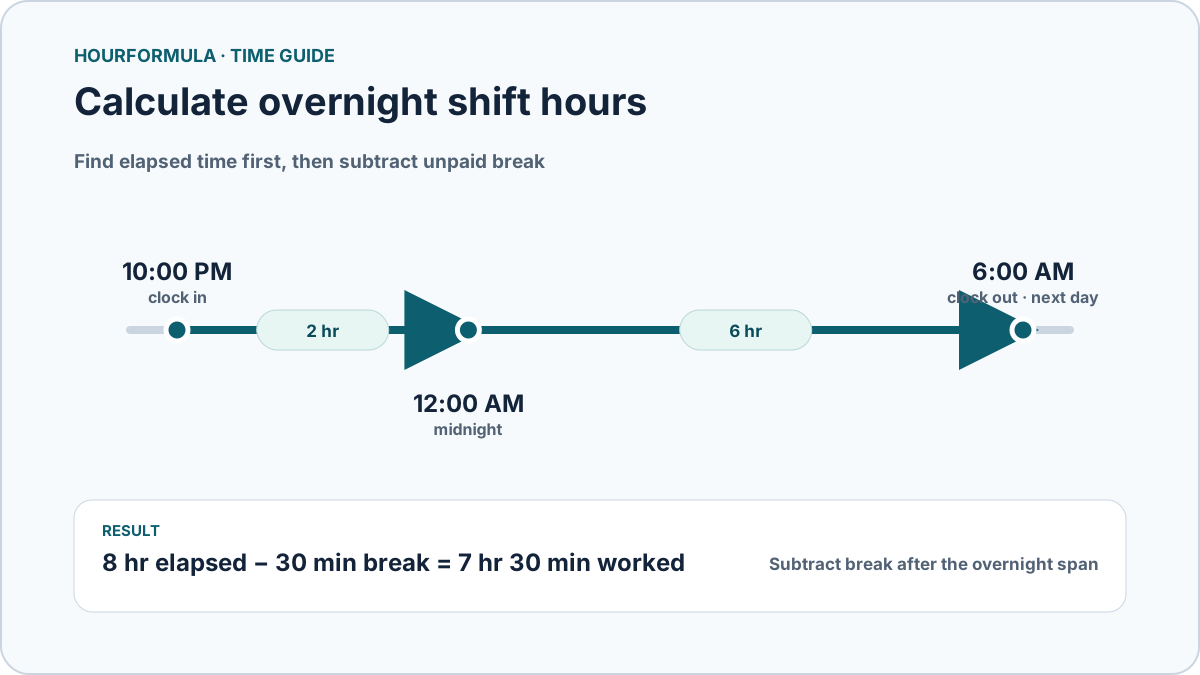
To calculate an overnight shift, treat the clock-out time as occurring on the next day whenever it is earlier than the clock-in time.
Example:
10:00 PM to 6:00 AM
Split it into:
- 10:00 PM to midnight = 2 hours
- Midnight to 6:00 AM = 6 hours
Total:
8 hours
With a 30-minute unpaid break:
8 hr − 30 min = 7 hr 30 min worked
The main difference between an overnight shift and a daytime shift is the midnight rollover. Once both times are placed on the correct timeline, the remaining arithmetic is the same.
 View larger image
Why normal subtraction fails across midnight
For 10:00 PM to 6:00 AM, the end time is not 6:00 AM on the same day. It belongs to the following day.
Think of midnight as the dividing point.
10:00 PM to midnight:
2 hours
Midnight to 6:00 AM:
6 hours
Total:
8 hours
Another method: calculate in minutes
10:00 PM is 22:00 in 24-hour time.
22 × 60:
1,320 minutes
6:00 AM:
360 minutes
Because the shift crosses midnight, add one day, or 1,440 minutes, to the end time:
360 + 1,440 = 1,800
Then:
1,800 − 1,320 = 480 minutes
480 ÷ 60:
8 hours
This is the same next-day rollover a deterministic calculator can apply automatically.
Overnight shift examples
Table:
| Clock in | Clock out | Unpaid break | Worked time |
|---|---|---|---|
| 10:00 PM | 6:00 AM | 0 min | 8 hr |
| 10:00 PM | 6:00 AM | 30 min | 7 hr 30 min |
| 11:00 PM | 7:00 AM | 0 min | 8 hr |
| 9:30 PM | 5:30 AM | 30 min | 7 hr 30 min |
| 11:45 PM | 4:15 AM | 0 min | 4 hr 30 min |
Subtract unpaid breaks after finding the overnight span
Example:
- Clock in: 9:00 PM
- Clock out: 5:30 AM
- Unpaid break: 45 minutes
9:00 PM to midnight = 3 hours.
Midnight to 5:30 AM = 5 hours 30 minutes.
Elapsed total:
8 hr 30 min
Subtract break:
8 hr 30 min − 45 min = 7 hr 45 min
Decimal form:
7.75 hours
What if the shift crosses midnight by only a few minutes?
The same rule still applies.
Example:
11:30 PM to 12:45 AM
11:30 PM to midnight = 30 minutes.
Midnight to 12:45 AM = 45 minutes.
Total:
1 hr 15 min
Decimal form:
1.25 hours
Crossing midnight changes the timeline, not necessarily the length of the shift.
What if the start and end times are the same?
A span such as:
8:00 PM to 8:00 PM
is ambiguous without dates or additional context.
It might mean zero elapsed time or a full 24-hour period.
Hourformula's normal work-hour tools are intended for typical single-shift calculations. Multi-day intervals require explicit dates to remove this ambiguity.
Overnight shifts and decimal hours
7 hr 30 min:
7.50 decimal hours
6 hr 20 min:
20 ÷ 60 ≈ 0.3333
Result:
approximately 6.33 decimal hours
Keep exact minutes during calculations and round only when needed for display.
Common overnight-shift mistakes
Treating the end time as the same day
10:00 PM to 6:00 AM is not negative four hours. The 6:00 AM clock-out belongs to the next day.
Adding a day when the shift does not cross midnight
A daytime shift such as 6:00 AM to 2:00 PM should be calculated normally.
Forgetting unpaid breaks
An 8-hour elapsed overnight span with a 30-minute excluded break represents 7 hr 30 min of worked time.
Confusing decimal time with clock notation
7 hr 30 min equals 7.50, not 7.30 decimal hours.
Using a single-shift calculation for a multi-day interval
Clock times alone cannot define a duration lasting more than one day.