
How to Calculate Time Duration
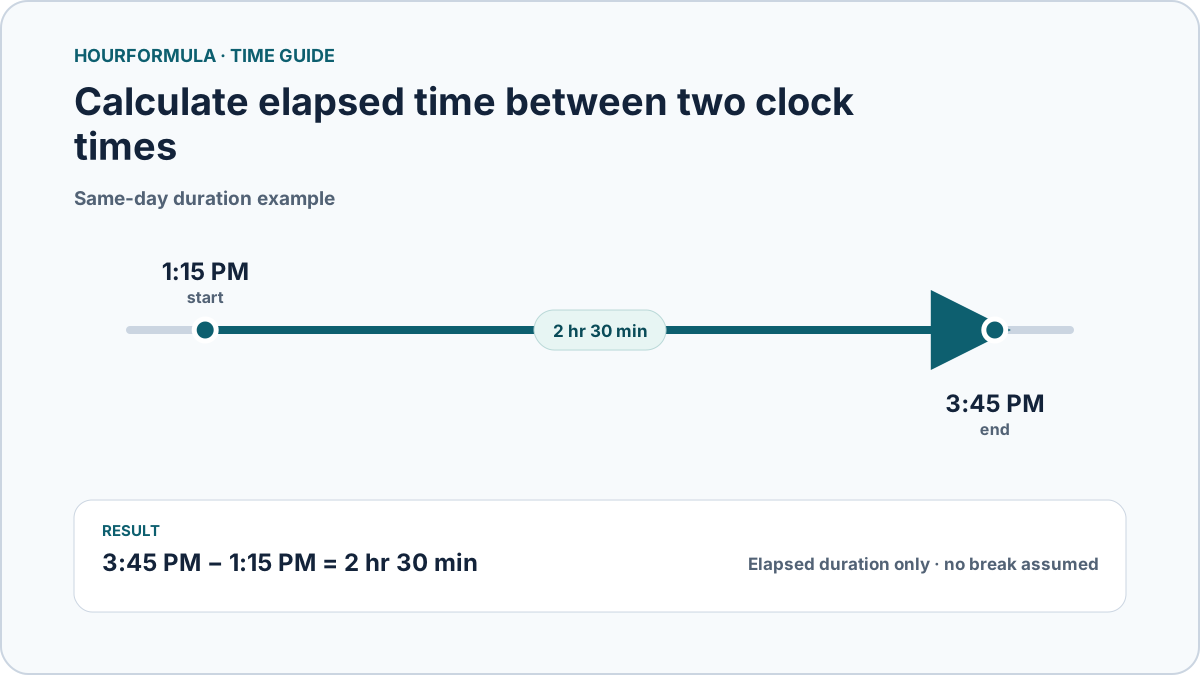
To calculate time duration, subtract the start time from the end time.
Duration = end time − start time
For example:
- Start: 1:15 PM
- End: 3:45 PM
The elapsed duration is:
2 hours 30 minutes
For simple same-day times, direct subtraction works well. For irregular minutes or an interval that crosses midnight, converting the times to minutes makes the arithmetic easier to verify.
 View larger image
Calculate a same-day duration
Suppose the start time is:
9:20 AM
and the end time is:
1:50 PM
Break the interval into convenient parts:
- 9:20 AM to 1:20 PM = 4 hours
- 1:20 PM to 1:50 PM = 30 minutes
Total:
4 hr 30 min
You can also use 24-hour time and minutes after midnight.
9:20 AM:
9 × 60 + 20 = 560 minutes
1:50 PM is 13:50:
13 × 60 + 50 = 830 minutes
Subtract:
830 − 560 = 270 minutes
270 minutes equals:
4 hr 30 min
Duration examples
| Start | End | Duration |
|---|---|---|
| 8:00 AM | 10:00 AM | 2 hr |
| 8:15 AM | 12:45 PM | 4 hr 30 min |
| 9:30 AM | 5:00 PM | 7 hr 30 min |
| 1:15 PM | 3:45 PM | 2 hr 30 min |
| 6:40 PM | 9:10 PM | 2 hr 30 min |
The calculation measures elapsed time only. It does not automatically subtract work breaks or decide whether any portion of the duration is paid.
Why minutes are useful
Subtraction becomes more reliable when both times are expressed in the same unit.
Example:
10:35 AM to 2:10 PM
Convert:
10:35 AM = 635 minutes after midnight
2:10 PM = 14:10 = 850 minutes after midnight
Subtract:
850 − 635 = 215 minutes
Convert 215 minutes:
- 180 minutes = 3 hours
- 35 minutes remain
Result:
3 hr 35 min
This avoids awkward borrowing when subtracting clock minutes by hand.
How to calculate a duration across midnight
If the end time is earlier than the start time and the interval crosses midnight, treat the end as occurring on the following day.
Example:
11:00 PM to 2:30 AM
11:00 PM to midnight = 1 hour.
Midnight to 2:30 AM = 2 hours 30 minutes.
Total:
3 hr 30 min
Another method is to add 24 hours to the next-day end time before subtracting.
Duration in hours and minutes
A duration such as:
3 hr 35 min
is often easiest to read in hours-and-minutes form.
If the total is stored in minutes, divide by 60:
215 ÷ 60 = 3 whole hours with 35 minutes remaining.
This representation preserves the exact minute value without decimal rounding.
Duration in decimal hours
To convert the same duration to decimal hours, divide total minutes by 60.
For 215 minutes:
215 ÷ 60 = 3.583333… hours
Rounded to two decimal places:
3.58 hours
For an exact half-hour value:
150 minutes ÷ 60 = 2.50 hours
Keep the exact minutes if the value will later be converted back or combined with other durations.
Duration is not the same as worked time
A time duration measures the full elapsed span between two times.
Example:
8:00 AM to 5:00 PM = 9 hours elapsed
If this represents a work shift with a 30-minute unpaid break, worked time might instead be:
8 hr 30 min
The duration calculation itself does not know that a break should be excluded.
For work-shift calculations, use:
What if the start and end times are identical?
A value such as:
8:00 AM to 8:00 AM
is ambiguous without date context.
It may mean:
- zero elapsed time; or
- a full 24-hour interval.
Hourformula's simple time-duration tools are intended for ordinary same-day or single-midnight-rollover calculations.
Intervals lasting a full day or multiple days require date information to remove the ambiguity.
Common duration-calculation mistakes
Avoid:
- subtracting minutes as though clock notation were decimal notation;
- treating an overnight end time as earlier on the same day;
- automatically subtracting work breaks from a neutral duration;
- rounding before the final calculation;
- assuming identical start and end times always represent 24 hours;
- confusing a time of day with an elapsed duration.