
Time Duration vs Decimal Hours
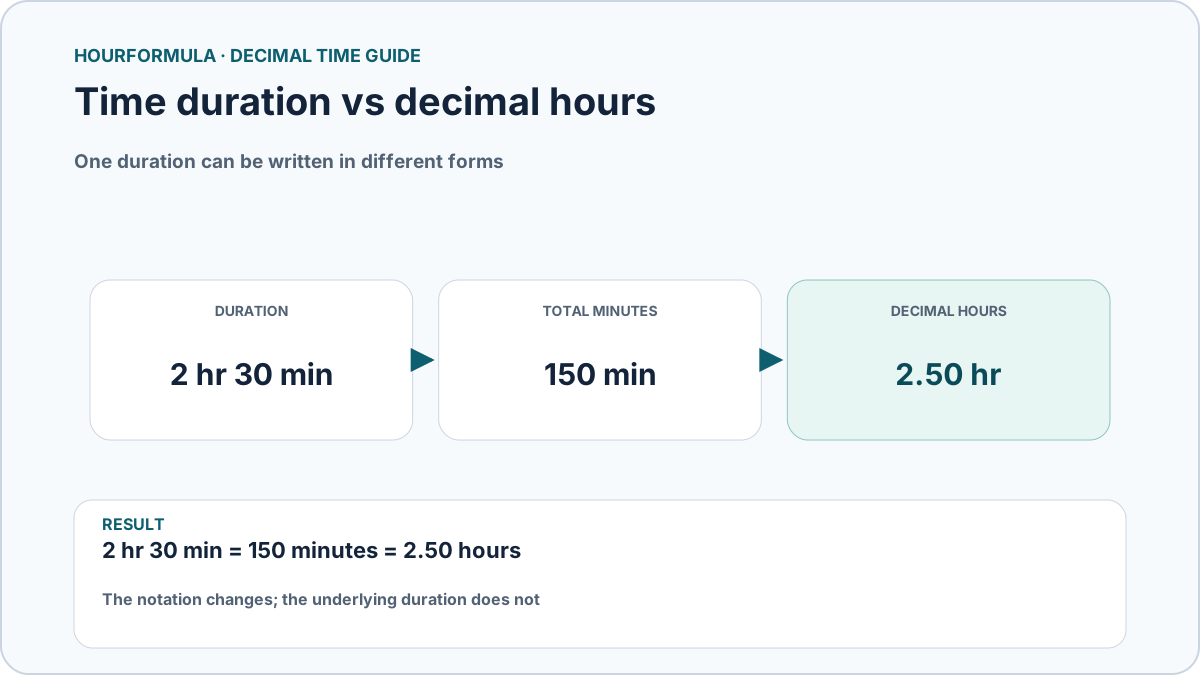
A time duration and decimal hours can describe the same amount of elapsed time using different formats.
Example:
2 hr 30 min = 2.50 decimal hours
Hours-and-minutes notation uses 60 minutes per hour.
Decimal hours express the minute portion as a base-10 fraction of an hour.
Neither format changes the underlying duration.
 View larger image
What is a time duration?
A duration is an amount of elapsed time.
Examples:
- 45 minutes
- 2 hr 15 min
- 7 hr 30 min
Duration notation is often easy to read because it matches the familiar hour-and-minute system.
For example:
1:15 PM to 3:45 PM has a duration of:
2 hr 30 min
What are decimal hours?
Decimal hours represent that duration numerically.
Use:
Decimal hours = total minutes ÷ 60
For 2 hr 30 min:
2 hours = 120 minutes.
120 + 30 = 150 minutes.
150 ÷ 60 = 2.50 hours
So:
2 hr 30 min = 2.50 decimal hours
Side-by-side examples
| Hours & minutes | Total minutes | Decimal hours |
|---|---|---|
| 15 min | 15 | 0.25 |
| 30 min | 30 | 0.50 |
| 45 min | 45 | 0.75 |
| 1 hr 15 min | 75 | 1.25 |
| 2 hr 30 min | 150 | 2.50 |
| 3 hr 20 min | 200 | 3.3333… |
| 7 hr 45 min | 465 | 7.75 |
Why 2 hr 30 min is not 2.30 hours
The 30-minute portion is half an hour.
Convert it:
30 ÷ 60 = 0.50
Therefore:
2 hr 30 min = 2.50 hours
A decimal value of 2.30 hours means:
0.30 × 60 = 18 minutes
So:
2.30 hours = 2 hr 18 min
This distinction is essential when switching between the two formats.
When hours and minutes are easier
Hours-and-minutes notation is often better for:
- reading elapsed time;
- schedules;
- human-friendly time summaries;
- checking clock-time differences.
For example:
3 hr 25 min
is immediately recognizable as a duration.
When decimal hours are easier
Decimal hours are often better for:
- arithmetic;
- multiplication;
- averaging numerical durations;
- adding values in software or spreadsheets.
Example:
Durations:
- 2 hr 30 min = 2.50
- 1 hr 45 min = 1.75
- 3 hr 15 min = 3.25
Add decimal values:
2.50 + 1.75 + 3.25 = 7.50 hours
Convert back:
7 hr 30 min
Converting duration to decimal hours
Example:
4 hr 20 min
Convert 20 minutes:
20 ÷ 60 = 0.3333…
Add whole hours:
4.3333… hours
Rounded to two decimal places:
4.33 hours
If accuracy matters, keep the exact minutes rather than relying on a rounded decimal for later reverse conversion.
Converting decimal hours back to duration
Example:
4.75 hours
Whole hours:
4
Fraction:
0.75
Convert the fraction:
0.75 × 60 = 45 minutes
Result:
4 hr 45 min
Rounding can change the reverse conversion slightly
20 exact minutes equals:
0.333333… hours
If displayed as 0.33 and converted back:
0.33 × 60 = 19.8 minutes
The original value was 20 minutes.
That small difference is caused by rounding.
A good workflow is to preserve exact total minutes as the source value and use decimal hours as a representation when arithmetic requires it.
Time of day is different from both
A clock value such as:
4:30 PM
is a time of day.
A value such as:
4 hr 30 min
is a duration.
A value such as:
4.50 hours
is decimal notation for that duration.
Do not treat these formats as interchangeable even when their numbers look similar.
Choose the format that fits the task
Use hours and minutes when readability is most important.
Use decimal hours when numerical arithmetic is more convenient.
Convert between them only when needed, and preserve exact minute values when rounding could matter.