
Time Card Hours and Minutes
Time-card hours and minutes use a base-60 time system.
That means 60 minutes make one hour.
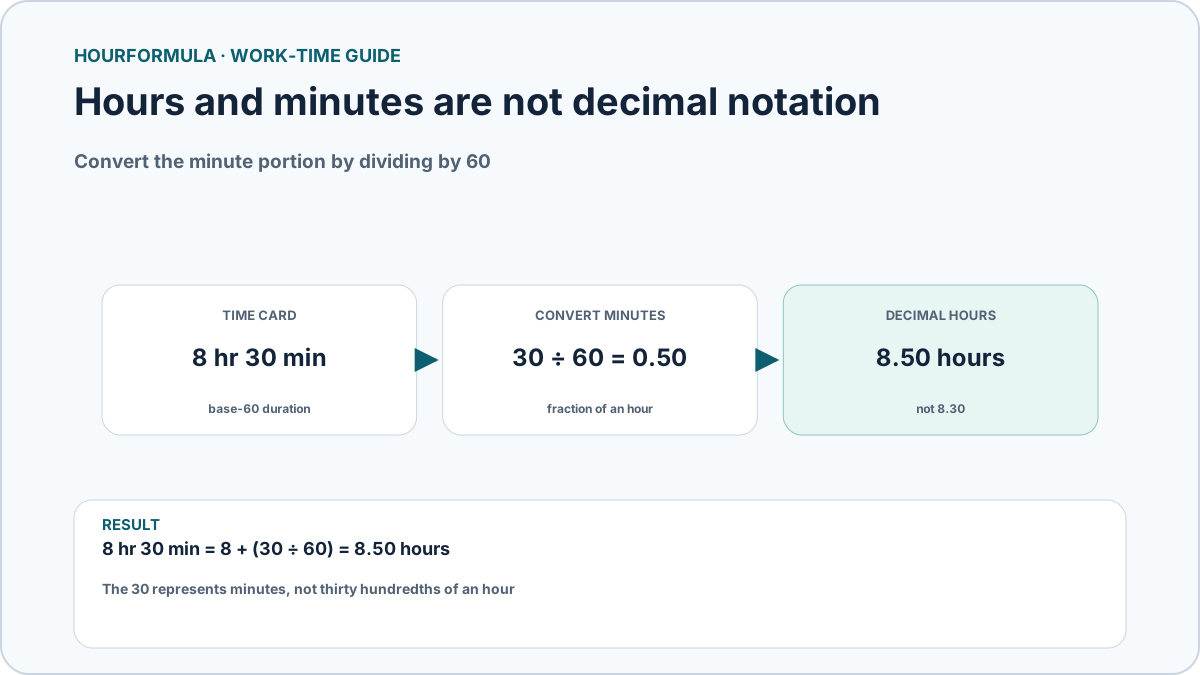
Decimal hours use base-10 fractions of an hour, so a time-card value such as 8 hr 30 min converts to 8.50 decimal hours, not 8.30.
Understanding this distinction prevents one of the most common work-time calculation mistakes.
 View larger image
Hours and minutes are not decimal notation
A duration written as:
8 hr 30 min
means:
- 8 whole hours;
- 30 of the 60 minutes in the next hour.
To convert the minute portion:
30 ÷ 60 = 0.50
Therefore:
8 hr 30 min = 8.50 decimal hours
The 30 in 8:30 represents minutes, not thirty hundredths of an hour.
Common minute-to-decimal values
Table:
| Minutes | Decimal fraction of an hour |
|---|---|
| 5 | 0.0833… |
| 10 | 0.1667… |
| 15 | 0.25 |
| 20 | 0.3333… |
| 30 | 0.50 |
| 45 | 0.75 |
| 60 | 1.00 |
How to add time-card hours and minutes
Suppose the daily totals are:
- Monday: 7 hr 45 min
- Tuesday: 8 hr 30 min
- Wednesday: 8 hr 15 min
Add whole hours:
7 + 8 + 8 = 23 hours
Add minutes:
45 + 30 + 15 = 90 minutes
90 minutes equals:
1 hr 30 min
Final total:
24 hr 30 min
Decimal form:
24.50 hours
Why calculating in minutes is often easier
The same example can be converted to total minutes:
- 7 hr 45 min = 465 min
- 8 hr 30 min = 510 min
- 8 hr 15 min = 495 min
Add:
465 + 510 + 495 = 1,470 minutes
Convert back:
1,470 ÷ 60 = 24 hours 30 minutes
Using minutes eliminates the need to manually carry every extra 60 minutes into another hour.
What does 8:30 mean on a time card?
Context matters.
8:30 AM can be a clock time.
8 hr 30 min can be a duration.
8.50 can be the decimal representation of an 8-hour-30-minute duration.
These values may describe related ideas, but they are different notations.
Avoid copying the digits after a colon directly into decimal-hour format.
When decimal hours are useful
Decimal hours are convenient when the time value will be multiplied by another number or added in a numerical system.
For example:
8 hr 30 min:
8.50 hours
At a hypothetical arithmetic rate of $20 per hour:
8.50 × 20 = 170
The conversion should happen before multiplication.
The calculation itself does not determine payroll rules, deductions, or whether particular time is compensable.
Avoid rounding too early
20 minutes equals:
0.3333… hours
If you immediately round this to 0.33 and then repeatedly add rounded daily values, a small difference can accumulate.
When possible:
- keep exact minutes;
- total the minutes;
- convert the final result to decimal hours;
- round only when needed.