
How to Subtract Hours and Minutes From a Time
To subtract hours and minutes from a time, move backward by the specified duration.
If the minute subtraction would become negative, borrow one hour as 60 minutes.
Example:
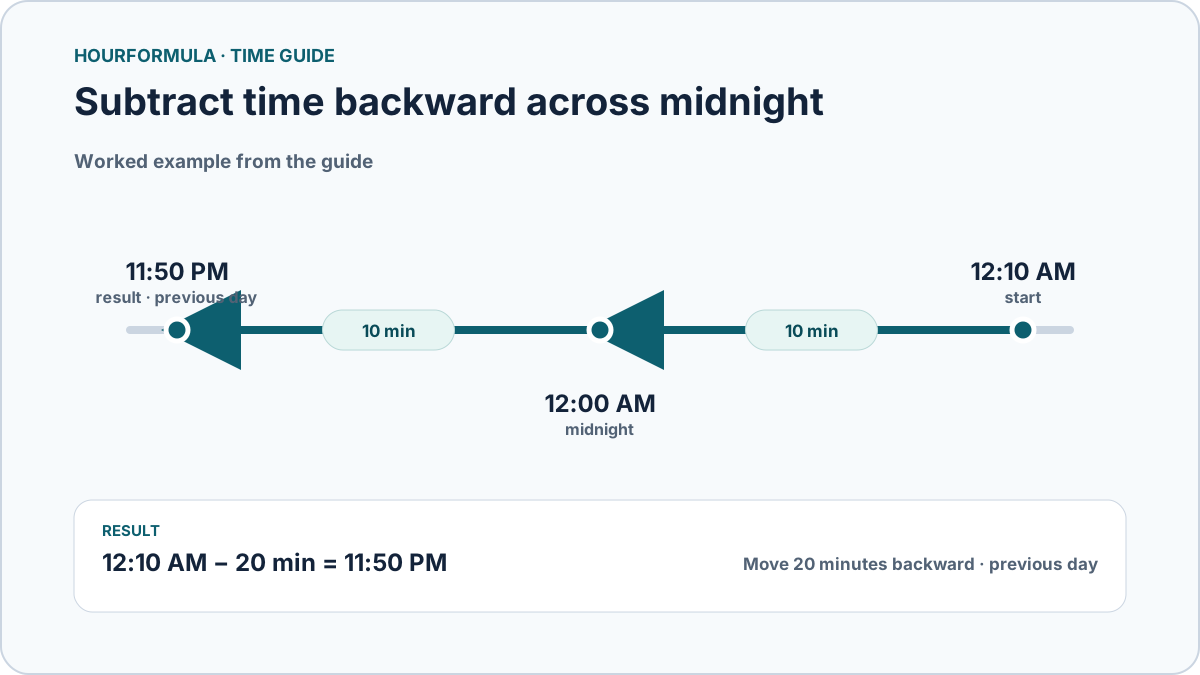
12:10 AM − 20 minutes = 11:50 PM
Because the subtraction crosses midnight, the result is on the previous day.
 View larger image
Subtract whole hours
Example:
5:30 PM − 3 hours
Move back three hours:
2:30 PM
No minute adjustment is needed because both values have the same minute position.
Subtract hours and minutes
Example:
4:20 PM − 2 hr 45 min
Subtract 2 hours:
4:20 PM → 2:20 PM
Now subtract 45 minutes.
Because 20 minutes is less than 45 minutes, borrow one hour:
2:20 PM becomes:
1 hour + 80 minutes
Now:
80 − 45 = 35 minutes
Result:
1:35 PM
Time-subtraction examples
| Starting time | Subtract | Result |
|---|---|---|
| 5:00 PM | 2 hr | 3:00 PM |
| 4:30 PM | 1 hr 45 min | 2:45 PM |
| 12:10 PM | 30 min | 11:40 AM |
| 9:15 AM | 2 hr 30 min | 6:45 AM |
| 12:10 AM | 20 min | 11:50 PM |
Subtract time using total minutes
For irregular values, converting to minutes can simplify the arithmetic.
Example:
6:25 PM − 3 hr 50 min
6:25 PM is 18:25.
Minutes after midnight:
18 × 60 + 25 = 1,105 minutes
Duration:
3 hr 50 min = 230 minutes
Subtract:
1,105 − 230 = 875 minutes
875 minutes after midnight = 14:35.
Result:
2:35 PM
This is the reverse of adding the same duration to 2:35 PM.
Subtracting across midnight
Example:
1:15 AM − 2 hours
One hour backward reaches:
12:15 AM.
Another hour backward reaches:
11:15 PM
The result is on the previous day.
A time-of-day calculator can show the correct clock value, but without a calendar date it cannot name the actual date.
Borrowing an hour means adding 60 minutes
Suppose you calculate:
3:10 PM − 45 minutes
You cannot subtract 45 directly from 10 minutes.
Borrow one hour:
3:10 PM becomes:
2 hr + 70 min
Now subtract:
70 − 45 = 25 minutes
Result:
2:25 PM
The borrowed hour is exactly 60 minutes.
Normalize unusual duration inputs first
If a duration is written as:
2 hr 90 min
90 minutes equals 1 hr 30 min.
So:
2 hr 90 min = 3 hr 30 min
Normalize the duration before subtracting to make the calculation easier to understand.
Subtraction and elapsed duration are different questions
Subtracting a duration answers:
What clock time is this many hours and minutes before the starting time?
A duration calculation instead asks:
How much time elapsed between two clock times?
The arithmetic is related, but the user intent is different.
Common mistakes
Avoid:
- subtracting minutes without borrowing an hour when needed;
- treating an hour as 100 minutes instead of 60;
- stopping at midnight instead of continuing into the previous day;
- confusing decimal hours with hours-and-minutes notation;
- assuming the result identifies an actual calendar date when no date was supplied.