
How to Convert Decimal Hours to Hours and Minutes
To convert decimal hours to hours and minutes:
- keep the whole-number portion as hours;
- multiply the decimal fraction by 60 to get minutes.
Minutes = decimal fraction × 60
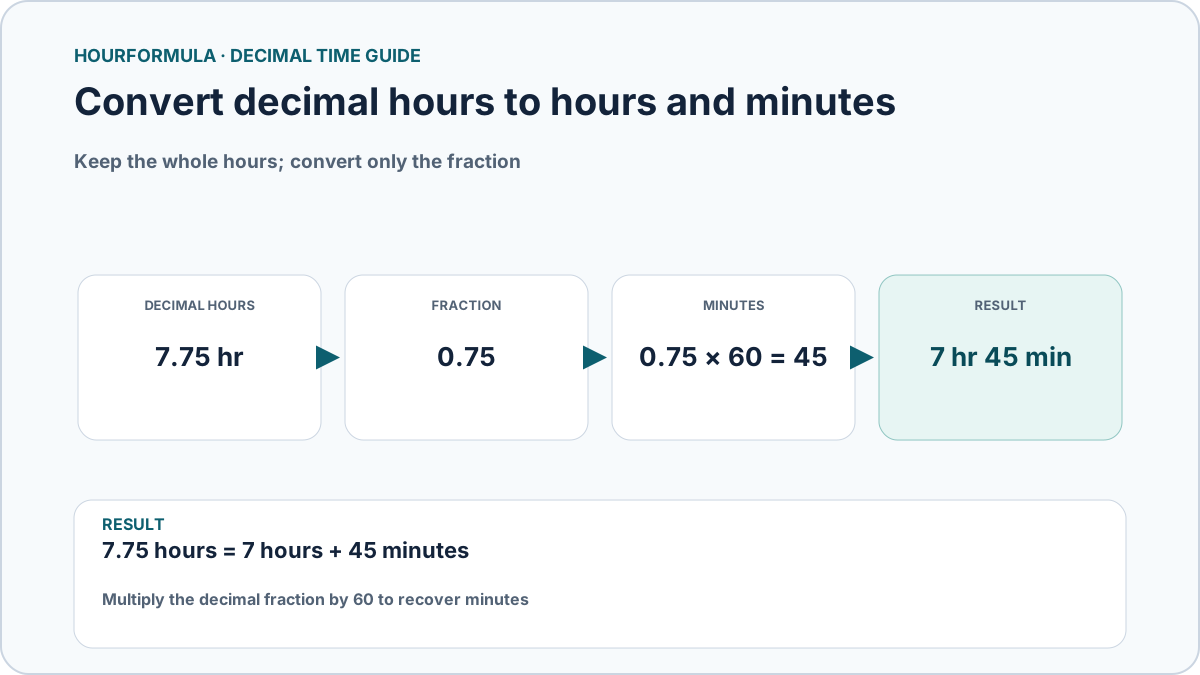
For example:
7.75 hours
Whole hours:
7
Decimal fraction:
0.75
Minutes:
0.75 × 60 = 45
Result:
7 hr 45 min
 View larger image
Step-by-step example
Convert:
8.50 hours
The whole-number portion is:
8 hours
The fractional portion is:
0.50
Convert the fraction:
0.50 × 60 = 30 minutes
Result:
8 hr 30 min
This is why 8.50 decimal hours corresponds to 8 hours 30 minutes.
Common decimal-hour conversions
| Decimal hours | Hours & minutes |
|---|---|
| 0.25 | 0 hr 15 min |
| 0.50 | 0 hr 30 min |
| 0.75 | 0 hr 45 min |
| 1.25 | 1 hr 15 min |
| 1.50 | 1 hr 30 min |
| 1.75 | 1 hr 45 min |
| 2.50 | 2 hr 30 min |
| 7.25 | 7 hr 15 min |
| 7.50 | 7 hr 30 min |
| 7.75 | 7 hr 45 min |
Converting decimals that do not end in .25, .50, or .75
Suppose you have:
6.33 hours
Keep:
6 hours
Convert the fraction:
0.33 × 60 = 19.8 minutes
If the decimal value is already rounded, the result is approximately 20 minutes.
So 6.33 hours is approximately:
6 hr 20 min
However, note that 20 exact minutes converts to 0.3333… hours, not exactly 0.33.
That means converting a rounded decimal back to minutes may not perfectly reproduce the original value.
Exact versus rounded decimal input
Consider:
6.333333… hours
Fraction:
0.333333… × 60 = 20 minutes
That returns the original 20-minute value exactly.
But if the number was shortened to 6.33 first:
0.33 × 60 = 19.8 minutes
The small difference comes from rounding, not from the conversion formula.
When possible, preserve the original minutes or higher-precision decimal value.
Why you should not read decimal digits as minutes
A value of:
4.30 hours
does not mean 4 hours 30 minutes.
Convert the decimal fraction:
0.30 × 60 = 18 minutes
Therefore:
4.30 hours = 4 hr 18 min
By contrast:
4 hr 30 min = 4.50 decimal hours
This is the reverse of the same base-60 versus base-10 distinction explained throughout decimal-time calculations.
Another example: 1.40 decimal hours
Whole hours:
1
Fraction:
0.40
Minutes:
0.40 × 60 = 24
Result:
1 hr 24 min
The digits .40 represent forty hundredths of an hour, not 40 minutes.
Decimal hours in work-time totals
Suppose a weekly total is stored as:
38.75 hours
Convert the fractional part:
0.75 × 60 = 45
Result:
38 hr 45 min
This format is often easier to read as a schedule or duration, while 38.75 may be easier to use in arithmetic.
Common mistakes
Avoid:
- reading .50 as 50 minutes;
- multiplying the entire decimal value by 60 when you only want the minute remainder;
- assuming a rounded decimal can always reconstruct the exact original minutes;
- confusing decimal duration with a time-of-day notation;
- rounding before the final step when precise source data is available.