
How to Convert Minutes to Decimal Hours
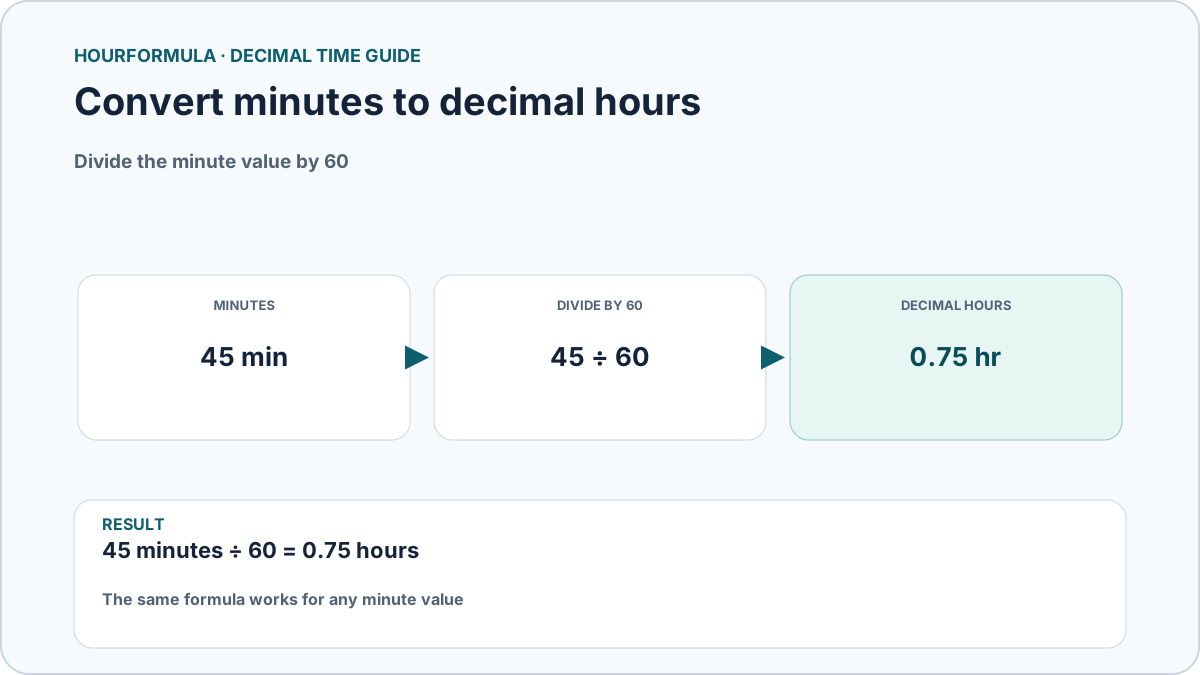
To convert minutes to decimal hours, divide the number of minutes by 60.
Decimal hours = minutes ÷ 60
For example:
45 minutes ÷ 60 = 0.75 hours
So 45 minutes equals 0.75 decimal hours.
For mixed durations, convert only the minute portion and then add it to the whole hours.
Example:
3 hr 20 min
20 ÷ 60 = 0.3333…
3 + 0.3333… = 3.3333… hours
Rounded to two decimal places:
3.33 hours
 View larger image
Why divide by 60?
One hour contains 60 minutes.
A minute is therefore one-sixtieth of an hour.
That means:
- 1 minute = 1 ÷ 60 hour
- 15 minutes = 15 ÷ 60 = 0.25 hour
- 30 minutes = 30 ÷ 60 = 0.50 hour
- 45 minutes = 45 ÷ 60 = 0.75 hour
The same formula works for any number of minutes.
Minute-to-decimal examples
| Minutes | Calculation | Decimal hours |
|---|---|---|
| 5 | 5 ÷ 60 | 0.0833… |
| 10 | 10 ÷ 60 | 0.1667… |
| 15 | 15 ÷ 60 | 0.25 |
| 20 | 20 ÷ 60 | 0.3333… |
| 30 | 30 ÷ 60 | 0.50 |
| 40 | 40 ÷ 60 | 0.6667… |
| 45 | 45 ÷ 60 | 0.75 |
| 50 | 50 ÷ 60 | 0.8333… |
| 55 | 55 ÷ 60 | 0.9167… |
| 60 | 60 ÷ 60 | 1.00 |
For more values:
Converting more than 60 minutes
The formula still works when the input is greater than one hour.
Example:
90 minutes
90 ÷ 60 = 1.50 hours
120 minutes:
120 ÷ 60 = 2.00 hours
150 minutes:
150 ÷ 60 = 2.50 hours
You do not need to separate the input into hours and minutes first, although doing so can make the result easier to interpret.
Converting hours and minutes together
Suppose the duration is:
8 hr 25 min
Keep the 8 whole hours.
Convert 25 minutes:
25 ÷ 60 = 0.416666…
Add the result:
8 + 0.416666… = 8.416666… hours
Rounded to two decimal places:
8.42 hours
Another example:
6 hr 10 min
10 ÷ 60 = 0.166666…
Result:
6.166666… hours
Rounded to two decimals:
6.17 hours
When should you round?
Not every minute value converts to a short decimal.
Values such as 15, 30, and 45 minutes convert exactly to 0.25, 0.50, and 0.75.
Values such as 10 or 20 minutes repeat indefinitely.
If the result is only for display, two decimal places may be convenient.
If several values will be added together, a safer method is to keep exact minutes until the total is complete.
Example:
Three separate 20-minute periods total:
60 minutes
Exact result:
1.00 hour
If each 20-minute period were rounded to 0.33 first:
0.33 + 0.33 + 0.33 = 0.99
That illustrates why early rounding can introduce a small difference.
Why .30 does not mean 30 minutes
A decimal fraction is based on tenths or hundredths of one whole hour.
0.30 hours means:
0.30 × 60 = 18 minutes
So:
- 0.25 hr = 15 min
- 0.30 hr = 18 min
- 0.50 hr = 30 min
- 0.75 hr = 45 min
This is one of the most important distinctions when working with decimal time.
A practical work-time example
Suppose a shift totals:
7 hr 50 min
Convert the minute portion:
50 ÷ 60 = 0.833333…
Add to the whole hours:
7 + 0.833333… = 7.833333… hours
Rounded to two decimal places:
7.83 hours
If you later need to return to hours and minutes, use the exact source minutes when possible rather than converting from an already rounded decimal.
Common mistakes
Avoid:
- dividing minutes by 100 instead of 60;
- writing 30 minutes as 0.30 hours;
- rounding each daily value before adding a larger total;
- treating a clock reading such as 8:45 AM as if it were a decimal duration;
- discarding the original minute value when exact conversion may be needed later.