
Quarter Hour Decimal Time
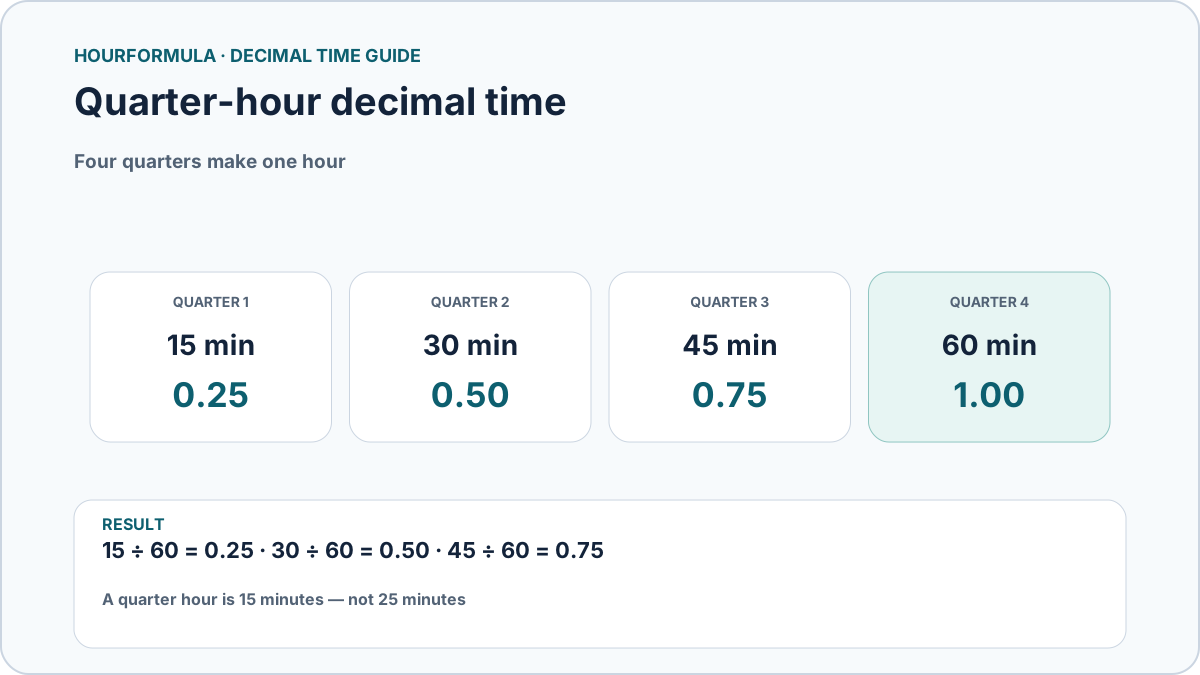
Quarter-hour increments convert neatly to decimal hours:
- 0 minutes = .00
- 15 minutes = .25
- 30 minutes = .50
- 45 minutes = .75
- 60 minutes = 1.00
The pattern comes from dividing minutes by 60.
15 ÷ 60 = 0.25
30 ÷ 60 = 0.50
45 ÷ 60 = 0.75
That makes quarter-hour increments especially easy to recognize in decimal time.
 View larger image
Quarter-hour decimal chart
| Minutes after the hour | Decimal fraction |
|---|---|
| 0 | .00 |
| 15 | .25 |
| 30 | .50 |
| 45 | .75 |
Examples:
| Hours & minutes | Decimal hours |
|---|---|
| 7 hr 0 min | 7.00 |
| 7 hr 15 min | 7.25 |
| 7 hr 30 min | 7.50 |
| 7 hr 45 min | 7.75 |
| 8 hr 0 min | 8.00 |
Why a quarter hour is .25
One hour contains 60 minutes.
A quarter of 60 is:
60 ÷ 4 = 15 minutes
A quarter written as a decimal is:
1 ÷ 4 = 0.25
Therefore 15 minutes equals 0.25 hour.
The same logic gives:
- two quarters = 30 min = 0.50 hr
- three quarters = 45 min = 0.75 hr
- four quarters = 60 min = 1.00 hr
Example calculations
8 hr 15 min
15 ÷ 60 = 0.25
Result:
8.25 hours
8 hr 30 min
30 ÷ 60 = 0.50
Result:
8.50 hours
8 hr 45 min
45 ÷ 60 = 0.75
Result:
8.75 hours
Quarter-hour values in a work-time total
Suppose daily worked durations are:
- Monday: 8 hr 15 min
- Tuesday: 7 hr 30 min
- Wednesday: 8 hr 45 min
Decimal values:
- 8.25
- 7.50
- 8.75
Total:
24.50 hours
That converts back to:
24 hr 30 min
What about times that are not on a quarter hour?
A value such as 8 hr 20 min is not one of the quarter-hour increments.
Convert normally:
20 ÷ 60 = 0.3333…
So:
8 hr 20 min = 8.3333… hours
Do not force the value to .25 or .50 unless a separate rounding rule explicitly requires that.
Hourformula's conversion tools should calculate from the actual minute value.
Quarter-hour notation is not clock notation
A value such as:
8.25 hours
means:
8 hr 15 min
It does not mean 8:25.
Likewise:
8.75 hours
means:
8 hr 45 min
not 8:75.
Decimal time and clock time use different notation.
Common mistakes
Avoid:
- thinking .25 means 25 minutes;
- writing 15 minutes as .15 hours;
- writing 30 minutes as .30 hours;
- forcing non-quarter-hour values into the .00/.25/.50/.75 pattern;
- treating decimal duration as a clock reading.